The Operating System for Women's Hormonal Health.
Transforming fragmented hormonal data into personalized, evidence-informed daily decisions.
Millions of women navigate fragmented hormonal care every day. Pistil brings every piece together into one intelligent, evidence-informed platform.
Healthcare treats women's hormones as separate problems.Women's bodies do not.
Each specialist sees a single piece. No one connects the whole. The misleading name 'PCOS' adds confusion, leaving patients to assemble fragmented advice into a coherent plan.
Current Situation — Value Proposition Canvas.
A diagnostic view of the women we serve, mapped against the value Pistil intends to deliver.
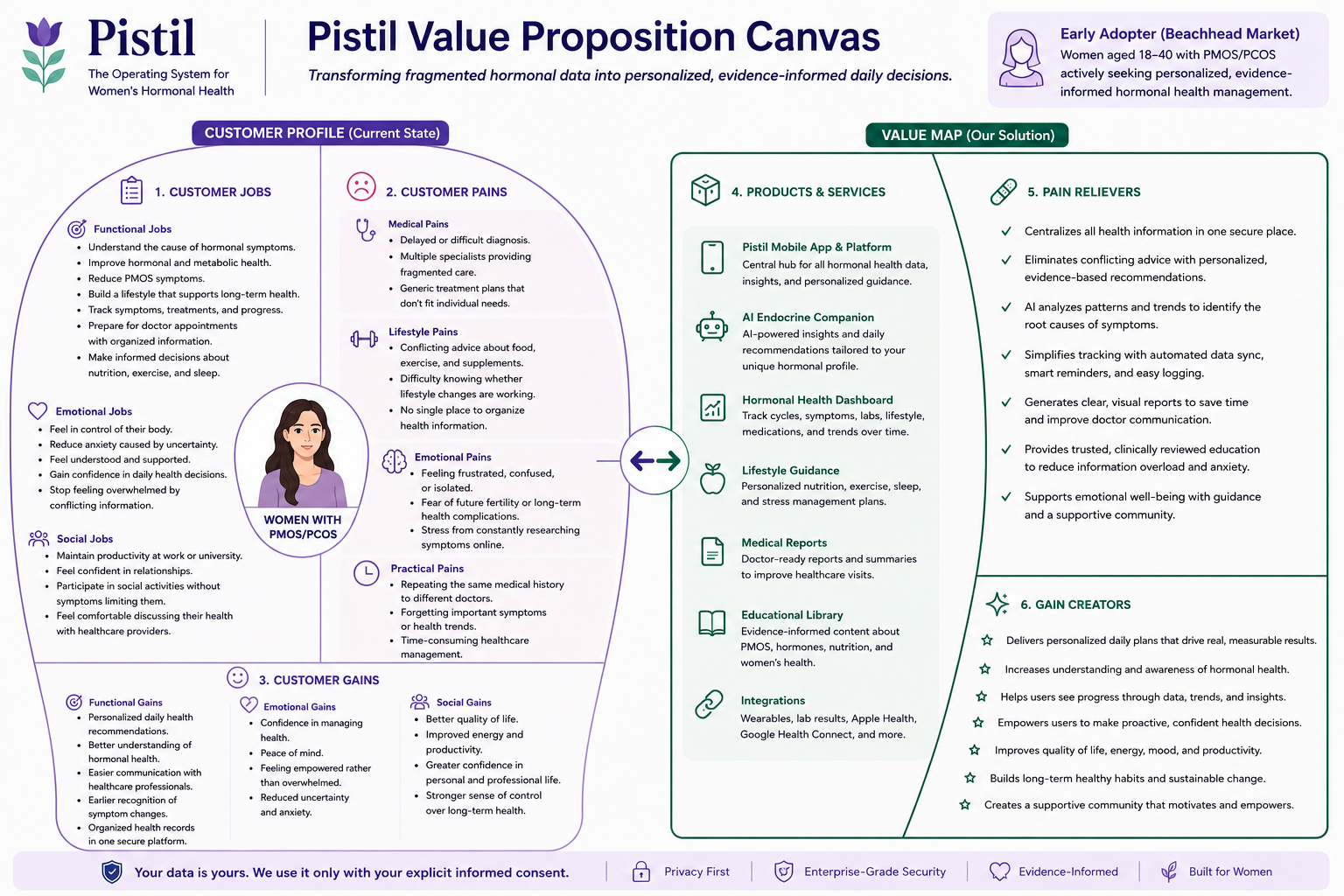
The canvas, in one paragraph.
The Value Proposition Canvas analyzes the current customer profile by identifying customer jobs, customer pains, and customer gains, then mapping them against Pistil's proposed value.
Customer Profile
Jobs women are trying to get done, the pains slowing them down, and the gains they want from managing hormonal health.
Value Map
The products, pain relievers, and gain creators Pistil delivers in response — mapped one-to-one against the profile.
Why it matters
Fit is not assumed. The canvas makes our hypotheses visible, testable, and accountable to real outcomes.
Defining the Need — problem, not nice-to-have.
We classify Pistil's opportunity against the three classic tiers. Only one of them justifies a company.
Problem
Fragmented hormonal care directly harms quality of life and long-term outcomes.
Need
A unified place where data, intelligence, and guidance live together — continuously.
Nice-to-Have
Aesthetics, gamification, and lifestyle nudges — meaningful only after the core need is solved.
The case in detail.
PMOS — Polyendocrine Metabolic Ovarian Syndrome, formerly known as PCOS — affects an estimated 1 in 8 women globally. A 2026 Lancet consensus, informed by 7,708 health professionals and patients across 34 societies on six continents, concluded the old name was misleading: the condition does not involve pathological ovarian cysts and is not an isolated gynecological disease.
It is a chronic, genetic, and lifestyle-related endocrine condition driven by hormonal changes including insulin resistance and hyperandrogenism. Its clinical features span reproductive, psychological, cardiometabolic, and dermatological health — yet care remains fragmented across gynecologists, endocrinologists, dermatologists, dietitians, fertility specialists, and primary care physicians. Patients are left to combine conflicting advice, monitor their own progress, and navigate misinformation, especially online.
With 76–86% of surveyed stakeholders supporting a name change, the global consensus has renamed the condition PMOS and established a five-year transition period. This is not a cosmetic rebranding; it is a signal that women's hormonal health needs unified, evidence-informed, and continuous support. Pistil centralizes hormonal data and turns it into personalized daily guidance — complementing clinicians, not replacing them.
The conditions for Pistil exist for the first time.
Three shifts have converged. Together they create a once-in-a-generation window to build the operating system women's hormonal health has always needed.
AI
Artificial intelligence now enables personalized health guidance at scale.
Connected Healthcare
Wearables, laboratory testing, and digital health records can finally work together.
Women's Health
The 2026 PMOS naming consensus reflects a broader cultural shift toward taking women's hormonal health seriously.
Our Proposed Solution — how Pistil works.
A modular platform that grows with her — from symptom tracking to AI-powered insight to clinical-grade reports.
Track
Cycles, symptoms, labs, wearables, lifestyle — captured effortlessly in one place.
Hormonal Health DashboardUnderstand
AI connects the dots across hormonal, metabolic and lifestyle signals.
AI Endocrine CompanionPersonalize
Daily guidance tuned to her unique profile — not generic advice.
Lifestyle GuidanceImprove
Measurable progress, fewer flare-ups, better conversations with clinicians.
Medical ReportsPistil Mobile App & Platform
Central hub for all hormonal health data, insights, and personalized guidance.
AI Endocrine Companion
AI-powered insights and daily recommendations tailored to your unique hormonal profile.
Hormonal Health Dashboard
Track cycles, symptoms, labs, lifestyle, medications, and trends over time.
Lifestyle Guidance
Personalized nutrition, exercise, sleep, and stress management plans.
Medical Reports
Doctor-ready reports and summaries that improve healthcare visits.
Educational Library
Evidence-informed content about PMOS, hormones, nutrition, and women's health.
Wearable Integrations
Apple Health, Google Health Connect, lab results, and future diagnostic tools.
Not another cycle tracker. An operating system.
Integrated Health Data
Symptoms, cycles, lifestyle, wearables, labs, and future diagnostics — unified in one secure place.
Personalized Guidance
Evidence-informed recommendations tailored to each woman's hormonal and metabolic profile.
Long-Term Trend Analysis
Surfaces meaningful patterns over months and years — not just daily logs.
Clinical Communication
Structured, longitudinal summaries make doctor visits faster and more productive.
Proactive Healthcare
Empower informed daily decisions before symptoms escalate.
Scalable Platform
Designed to extend beyond PMOS to endometriosis, thyroid, perimenopause and menopause.
Competitor & Alternative Analysis.
We benchmarked Pistil against the leading women's health apps. Each does one thing well. None do this.
| Capability | Flo | Clue | Ovia | Natural Cycles | Oura | Pistil |
|---|---|---|---|---|---|---|
| Cycle Tracking | ||||||
| Hormonal Intelligence | ||||||
| Lifestyle Guidance | ||||||
| Clinical Reports | ||||||
| Wearable Integration | ||||||
| AI Personalization | ||||||
| PMOS Support | ||||||
| Long-Term Health Insights |
A sustainable engine for long-term women's health.
The nine blocks of the Business Model Canvas — summarized faithfully from our working document.
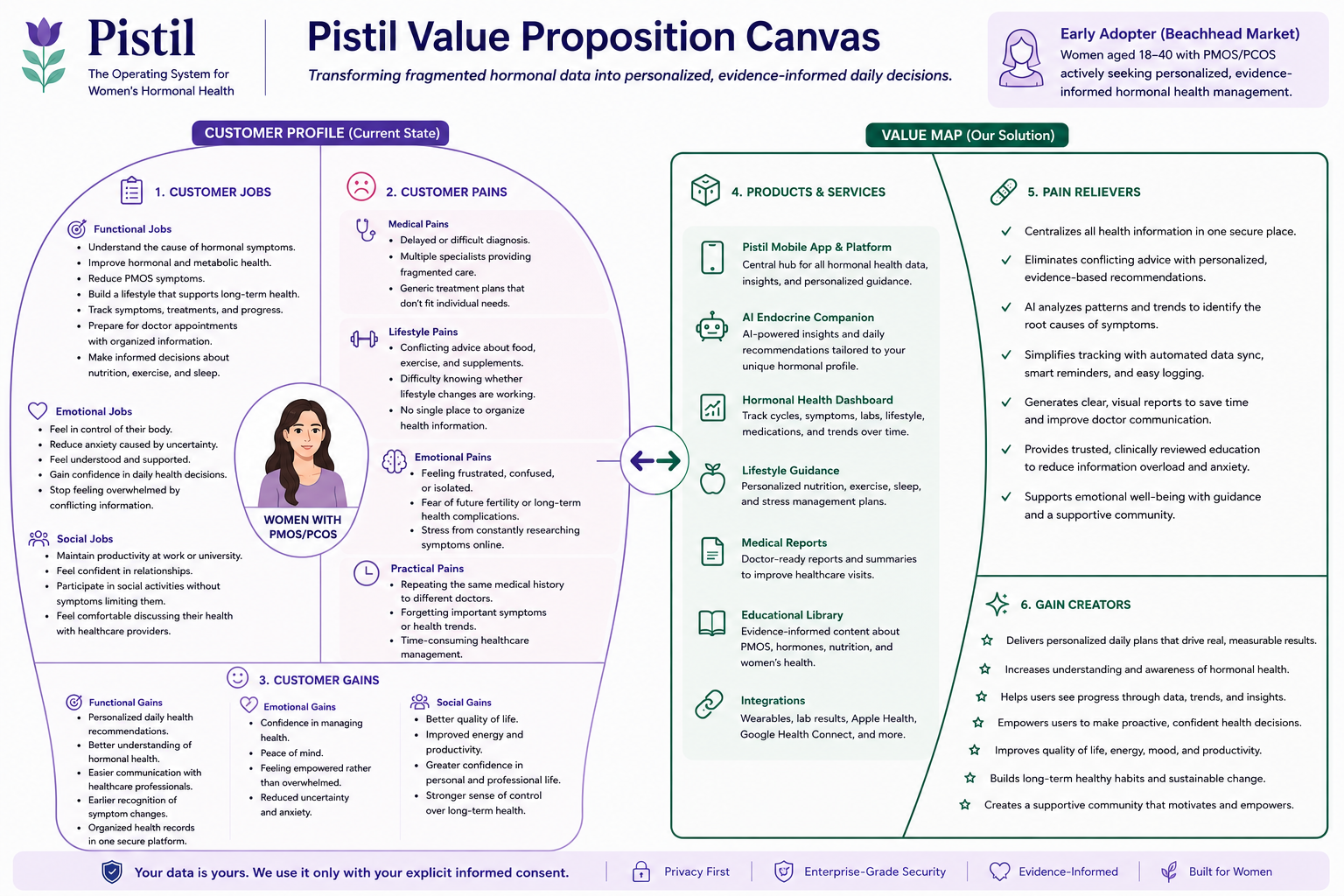
The artifact above is the source of truth. The nine cards below summarize each block faithfully — designed to be read at a glance.
Customer Segments
Women 18–40 with PMOS/PCOS actively seeking personalized hormonal health management; later: endometriosis, thyroid, perimenopause and menopause cohorts.
Value Propositions
Centralized hormonal data, AI-driven personalized guidance, evidence-informed lifestyle plans, and doctor-ready medical reports.
Channels
Direct mobile app (iOS / Android), web platform, content & community, clinical partnerships and women's health practitioners.
Customer Relationships
Self-serve with always-on AI companion, supportive community, and continuous personalization that deepens over time.
Revenue Streams
Freemium subscriptions, premium tiers for advanced AI insights, B2B partnerships with clinics, and integrations with diagnostics providers.
Key Resources
Proprietary hormonal health dataset, clinical advisory board, AI/ML models, security infrastructure, and brand trust.
Key Activities
Product engineering, ML modeling, clinical content curation, evidence reviews, regulatory compliance, and community moderation.
Key Partners
Clinicians and endocrinology networks, wearables (Apple Health, Google Health Connect), labs, research institutions, and women's health NGOs.
Cost Structure
Engineering and AI infrastructure, clinical content & advisors, compliance & security, customer acquisition, and community operations.
One platform. An entire life.
Pistil starts with PMOS and grows into every hormonal phase a woman experiences.
- TodayToday
- ConditionsPMOS
- ConditionsEndometriosis
- ConditionsThyroid Disorders
- Life StagesPregnancy
- Life StagesPostpartum
- Life StagesPerimenopause
- Life StagesMenopause
- PlatformFuture Diagnostics
- PlatformClinical Partnerships
- HorizonThe Future of Women's Hormonal Health
“Pistil empowers women to understand, manage, and improve their hormonal health through intelligent, evidence-informed technology.”
The evidence behind Pistil.
Primary sources used in this case study, formatted APA-style for academic review.
Teede, H. J., Khomami, M. B., Morman, R., et al. (2026). Polyendocrine metabolic ovarian syndrome, the new name for polycystic ovary syndrome: a multistep global consensus process. The Lancet.
World Health Organization (2025). Polycystic ovary syndrome (PCOS). WHO Health Topics.
Teede, H. J., et al. (2023). International Evidence-based Guideline for the Assessment and Management of Polycystic Ovary Syndrome. Monash University.
Flo Health (2025). Menstrual cycle & women's health tracking. flo.health.
Clue (2025). Cycle tracking and reproductive health education. helloclue.com.
Ovia Health (2025). Fertility, pregnancy and family-planning support. oviahealth.com.
Natural Cycles (2025). Fertility awareness and digital contraception. naturalcycles.com.
Oura Health (2025). Sleep, recovery and physiological monitoring. ouraring.com.